
Let’s be honest for a moment.
Most small businesses don’t fail because their product is bad.
However, they often fail because customers simply don’t know they exist.
Therefore, they try everything, hoping something works.
First, they print flyers.
Then come boosted Instagram posts.
After that, friends are asked to share stories.
Eventually, random ads are thrown into the mix.
Unfortunately, after spending thousands of rupees, nothing really changes.
There are no consistent leads.
Sales remain unpredictable.
And returns stay unclear.
Over time, marketing starts to feel less strategic and more like gambling.
You put money in and hope something comes out.
That’s exactly where performance marketing changes the game.
You stop hoping and start measuring.
Data replaces guesswork.
As a result, you pay only for results, not blind spending.
As a result, every rupee becomes accountable.
Today, startups, small businesses, and even global brands rely heavily on performance marketing because it offers something traditional advertising never could — predictable growth.
In this complete guide, you will learn everything about performance marketing, from the basics to advanced strategies, along with real examples, practical tips, and proven frameworks you can actually use.
What is Performance Marketing?
In the simplest terms, performance marketing is a type of digital marketing where you pay only when a specific action happens.
That action could be:
- a click
- a form submission
- a call
- a signup
- or a sale
Therefore, instead of paying for “exposure,” you pay for “results.”
This small difference makes a massive impact.
For example, imagine spending ₹5,000 on a newspaper ad. You have no idea how many people saw it or responded.
Now compare that with performance marketing.
If you spend ₹5,000 on ads and get 50 leads, you instantly know:
Cost per lead = ₹100
That clarity helps you decide whether to scale or improve.
Because of this measurability, performance marketing is far more efficient and profitable than traditional methods.
Why Performance Marketing is Replacing Traditional Advertising
Traditional advertising worked earlier because competition was low.
However, times have changed.
Customers now live online. They scroll Instagram, search on Google, and watch YouTube daily.
So offline ads struggle to grab attention.
Moreover, they are expensive and untrackable.
Let’s compare quickly:
Traditional Marketing
- No clear tracking
- Mass targeting
- High cost
- Slow feedback
- Risky
Performance Marketing
- Full tracking
- Laser targeting
- Budget control
- Fast results
- Low risk
Therefore, it’s obvious why businesses are shifting towards performance marketing.
Because today, decisions must be based on numbers, not assumptions.
How Performance Marketing Actually Works (Step-by-Step System)
Many people think ads are complicated.
In reality, performance marketing follows a logical process.
Once you understand this system, everything becomes easier.
Step 1 – Goal Setting in Performance Marketing
First, define your objective.
Because without clarity, campaigns fail.
Ask yourself:
Do I want:
- leads?
- calls?
- purchases?
- app installs?
For example, a real estate agent wants inquiries, while an ecommerce store wants sales.
Therefore, goals shape the strategy.
Step 2 – Audience Research in Performance Marketing
Next, identify who your ideal customer is.
This is extremely important.
Instead of showing ads to everyone, you show ads only to likely buyers.
For instance:
- 25–40 years old
- lives in Mumbai
- interested in fitness
- searches for gym membership
Now your money reaches the right people.
As a result, conversion rates increase.
Step 3 – Platform Selection in Performance Marketing
Not every platform works the same.
In fact, this is where many businesses make costly mistakes.
They assume running ads anywhere will bring results. However, each platform behaves differently, attracts different users, and serves a completely different purpose in the performance marketing journey.
Therefore, choosing the right platform is not optional — it directly impacts your cost, leads, and overall ROI.
Think of platforms like tools.
You wouldn’t use a hammer to tighten a screw. Similarly, you shouldn’t use the wrong ad platform for the wrong goal.
Let’s understand how each major channel fits into your performance marketing strategy.
Google Ads in Performance Marketing – Capturing High Intent
Google Ads work best when people are already searching for a solution.
This is extremely important.
Because when someone searches on Google, they usually have intent.
For example:
- “best dentist near me”
- “digital marketing agency in Mumbai”
- “buy running shoes online”
- “AC repair service today”
These users are not casually browsing. They are actively looking to take action.
Therefore, they are much closer to buying.
As a result, Google Ads often deliver faster conversions compared to other platforms.
That’s why Google is considered one of the strongest channels in performance marketing, especially for service-based businesses.
It works exceptionally well for:
- doctors and clinics
- coaches and consultants
- real estate agents
- agencies
- local services
- ecommerce products with demand
For instance, if someone searches “wedding photographer Mumbai,” they are probably planning a wedding soon. Showing your ad at that moment dramatically increases the chance of getting a lead.
So instead of chasing customers, Google helps you meet them exactly when they need you.
Because of this high intent, Google Ads may cost slightly more per click. However, the conversion rate is usually higher, which balances the cost.
Meta Ads in Performance Marketing – Creating Demand and Awareness
While Google captures existing demand, Meta Ads create new demand.
Platforms like Facebook and Instagram work differently.
Here, people are not searching for products. They are scrolling for entertainment.
Because of this, your ads must capture attention quickly and spark immediate interest.
This makes Meta ideal for discovery and awareness.
For example:
Someone scrolling Instagram might not actively search for a “fitness trainer.”
However, once they see an attractive ad showcasing transformation results, their interest can quickly spark.
That’s how demand is created.
What’s more, Meta provides extremely powerful targeting options.
You can target users based on:
- age
- location
- interests
- behaviors
- job titles
- shopping habits
This means you can reach very specific audiences.
For instance:
- gym lovers
- startup founders
- new parents
- fashion shoppers
- students preparing for exams
Because of this precision, performance marketing on Meta becomes very effective for:
- brand awareness
- lead generation
- ecommerce
- course creators
- lifestyle brands
- local promotions
Additionally, Meta Ads are usually cheaper per click than Google. Therefore, you can generate large volumes of traffic at lower costs.
However, since users are not actively searching, nurturing and retargeting become important.
Remarketing in Performance Marketing – Converting Warm Audiences
Remarketing is where true magic happens.
In fact, many experts say remarketing is the most profitable part of performance marketing.
Here’s why.
Not everyone buys the first time they see your ad.
Some users:
- visit your website
- check prices
- compare options
- then leave
If you don’t follow up, you lose them forever.
Remarketing solves this problem.
It allows you to show ads specifically to people who already interacted with your business.
For example:
- visited your website
- clicked your ad
- added products to cart
- watched your video
- engaged with your Instagram page
Since these users already know you, trust is higher.
Therefore, conversions become easier and cheaper.
Imagine this situation:
A customer visits your site but doesn’t book.
Later, they see your ad again saying:
“Still looking for digital marketing services? Get a free consultation today.”
This reminder often brings them back.
As a result, remarketing usually gives:
- lower cost per lead
- higher conversion rates
- better ROI
That’s why no performance marketing strategy is complete without remarketing campaigns.
Why Combining Platforms Works Best in Performance Marketing
Now here’s the important part.
Using only one platform limits your growth.
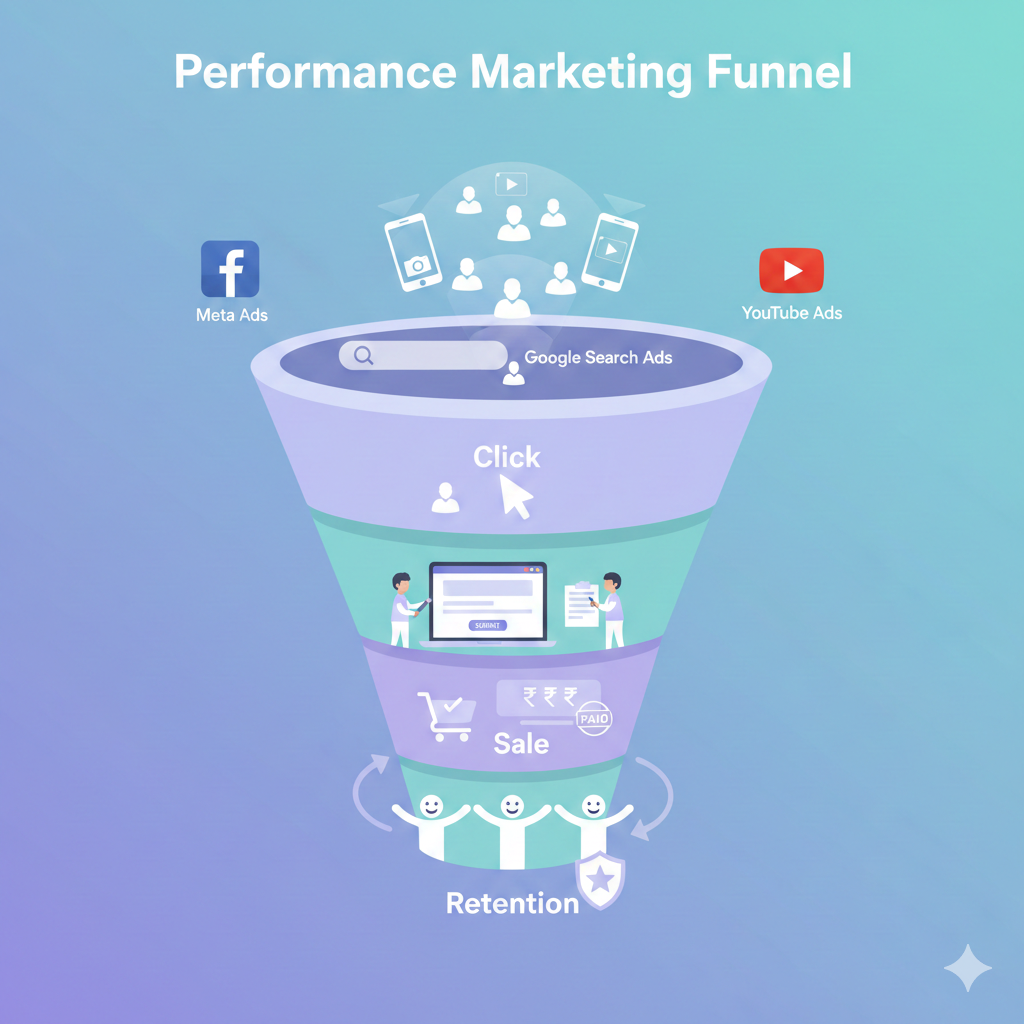
However, combining platforms creates a full funnel.
Think of it like this:
Google Ads → captures ready buyers
Meta Ads → creates awareness
Remarketing → converts visitors
Together, they cover the entire customer journey.
For example:
A person sees your Instagram ad.
Later, they search your brand on Google.
Then they visit your website.
Finally, remarketing reminds them to purchase.
This multi-touch journey increases trust and boosts conversions.
Therefore, the smartest performance marketing strategies don’t rely on a single platform. Instead, they use each platform for its strength.
That’s how you reduce costs, increase leads, and scale profitably.
Step 4 – Ad Creation in Performance Marketing
Good ads don’t look complicated.
They look clear and direct.
Focus on:
- problem
- solution
- benefit
- call-to-action
For example:
“Struggling to get clients? Get 30 qualified leads monthly with our marketing system. Book a free call today.”
Simple messaging works best.
Step 5 – Tracking & Optimization in Performance Marketing
This is where the real magic happens.
In fact, this step is what separates performance marketing from regular advertising.
Because without tracking, you are simply spending money.
However, with tracking, you are making informed business decisions.
And that difference changes everything.
Many businesses run ads but never check the data properly. They look at likes or comments and feel happy. Unfortunately, likes don’t pay bills.
Conversions do.
Therefore, tracking is the backbone of successful performance marketing.
It tells you exactly what is working, what is failing, and where your money should go.
Why Tracking is So Important in Performance Marketing
Imagine running three ads at the same time.
You spend ₹1,000 on each.
Without tracking, you won’t know:
- which ad got leads
- which ad wasted money
- which audience converted
So you keep spending blindly.
Now imagine you have proper tracking.
You instantly see:
Ad A → 20 leads
Ad B → 5 leads
Ad C → 0 leads
Suddenly, decisions become obvious.
First, you stop Ad C.
Then, you improve Ad B.
Finally, you increase the budget for Ad A.
As a result, your overall results improve without increasing total spend.
That’s the power of performance marketing.
You don’t need more money.
You just need better data.
Tools Used for Tracking in Performance Marketing
Tracking sounds technical, but it’s actually simple once set up.
Here are the most common tools:
Pixels
Small codes installed on your website that track visitor actions.
For example:
- page views
- form submissions
- purchases
- button clicks
Meta Pixel and Google Tag are widely used.
These pixels help you understand what users do after clicking your ad.
Conversion Tracking
This shows which ads generate results.
For instance, you can track:
- leads
- calls
- sales
- downloads
So instead of guessing, you know the exact source of every conversion.
Analytics Tools
Platforms like Google Analytics give deeper insights such as:
- how long users stay
- which pages they visit
- where they drop off
- which traffic source performs best
These insights help refine your strategy.
Together, these tools make performance marketing measurable and transparent.
What Exactly Should You Track?
Not every number matters.
Focus only on meaningful metrics.
For example:
- cost per click (CPC)
- cost per lead (CPL)
- cost per acquisition (CPA)
- conversion rate
- return on ad spend (ROAS)
These metrics tell you whether campaigns are profitable.
Because at the end of the day, revenue matters more than impressions.
Understanding Optimization in Performance Marketing
Tracking gives you data.
However, optimization turns that data into profit.
Optimization simply means improving performance step by step.
Instead of running ads and forgetting them, you continuously test and refine.
For example:
If one headline performs better → use it more
If one audience converts cheaper → increase budget
If one ad wastes money → pause it
Small improvements create big differences over time.
Consequently, optimization must be treated as an ongoing process rather than a one-time effort.
Not a one-time task.
Practical Example of Optimization
Let’s take a simple scenario.
You run three ads for a coaching class.
Week 1 Results:
Ad 1 → ₹50 per lead
Ad 2 → ₹120 per lead
Ad 3 → ₹90 per lead
Clearly, Ad 1 is best.
At this point, you might be wondering — what should you do?
You pause Ad 2.
Next, new creatives are tested for Ad 3.
Meanwhile, the budget for Ad 1 is doubled.
Week 2 Results:
Average cost per lead drops to ₹45.
Same budget. Better results.
This is how performance marketing improves efficiency.
Not by luck. But by smart decisions.
Continuous Testing in Performance Marketing
Testing is extremely important.
Because what works today may not work tomorrow.
Audience behavior changes.
Trends change.
Creatives get stale.
Therefore, you should always test:
- different headlines
- different images
- different videos
- different audiences
- different landing pages
Even small changes can increase conversions dramatically.
For example, changing just one headline might increase clicks by 30%.
Over time, these small gains compound.
That’s how campaigns become highly profitable.
The “Pause and Scale” Strategy
Every successful performance marketing campaign follows this rule:
Pause losers. Scale winners.
It sounds simple, but many businesses ignore it.
They keep running poor ads because they “look nice.”
Instead, focus only on numbers.
If something isn’t converting, stop it immediately.
If something is profitable, invest more.
Because your budget should always flow towards results.
How Optimization Improves ROI Over Time
At first, results may be average.
That’s normal.
However, as you collect data and optimize, performance keeps improving.
Week by week:
- costs reduce
- conversions increase
- ROI grows
Eventually, you build a system that consistently generates leads; consequently, your ROI improves without constant guesswork.
At that point, performance marketing becomes predictable.
And predictable growth is every business owner’s dream.
Why Many Businesses Fail at This Step
Ironically, this is where most businesses fail.
They:
- run ads once
- never check data
- stop too early
- don’t test creatives
As a result, they think ads don’t work.
In reality, they simply didn’t optimize.
Remember, ads are not “set and forget.”
They require monitoring and improvement.
Therefore, consistency is key.
Top Channels Used in Performance Marketing
Let’s now explore the best channels used in performance marketing.
Google Ads for Performance Marketing
Google Ads work when users actively search.
For example:
“digital marketing agency near me”
That person already wants the service.
Therefore, conversions happen faster.
Google Ads are ideal for:
- service businesses
- agencies
- clinics
- consultants
If you want quick leads, Google is powerful.
Meta Ads for Performance Marketing
Facebook and Instagram help you reach new audiences.
Even if users are not searching, they discover your brand through creative ads.
Moreover, targeting options are strong.
You can target based on:
- interests
- behavior
- demographics
- location
Hence, awareness grows quickly.
Remarketing in Performance Marketing
Remarketing targets users who already visited your website.
Since they know your brand, trust is higher.
As a result, conversions are cheaper.
Many businesses get their best ROI from remarketing campaigns.
Key Metrics That Matter in Performance Marketing
Without metrics, performance marketing becomes nothing more than blind spending.
You might feel busy running ads.
You might see likes and clicks.
However, if you don’t track the right numbers, you are simply guessing.
And guessing is expensive.
Successful businesses don’t rely on assumptions. Instead, they rely on data.
Because data shows reality.
It tells you:
- what’s working
- what’s failing
- where money is wasted
- where profits are coming from
Therefore, tracking metrics is not optional in performance marketing. It is absolutely essential.
In fact, these numbers act like a health report for your campaigns.
Just like a doctor checks blood pressure and sugar levels, a marketer checks metrics to understand performance.
Let’s break down the most important ones in simple terms.
CPC – Cost Per Click in Performance Marketing
CPC means Cost Per Click.
It tells you how much you pay every time someone clicks your ad.
Formula:
Total ad spend ÷ number of clicks
Example:
You spend ₹1,000
You get 200 clicks
CPC = ₹5 per click
Simple.
Now why does this matter?
Because CPC shows how expensive your traffic is.
If your CPC is too high, you will burn your budget quickly. On the other hand, if CPC is low, you can attract more visitors for the same money.
However, here’s an important point.
Lower CPC doesn’t always mean better performance.
Sometimes cheap clicks don’t convert.
For instance:
- CPC ₹3 but no leads → useless
- CPC ₹10 but high sales → profitable
Therefore, CPC should always be analyzed along with conversions.
Still, optimizing CPC helps you control costs and improve efficiency in performance marketing.
CTR – Click Through Rate in Performance Marketing
CTR means Click Through Rate.
It shows how many people clicked your ad after seeing it.
Formula:
(Clicks ÷ Impressions) × 100
Example:
Your ad is shown to 1,000 people
50 people click
CTR = 5%
Now what does this tell you?
CTR measures how attractive your ad is.
If people don’t click, it usually means:
- weak headline
- boring creative
- wrong audience
- unclear offer
Because think about it.
If your ad is interesting, people naturally click.
So a higher CTR means your ad message is resonating.
In performance marketing, improving CTR often reduces costs too.
Why?
Because platforms like Google and Meta reward engaging ads with lower CPC.
So better CTR → cheaper clicks → better ROI.
That’s a win-win.
Conversion Rate in Performance Marketing
Getting clicks is good.
However, clicks alone don’t pay the bills.
Conversions do.
That’s why conversion rate is extremely important in performance marketing.
It tells you how many visitors actually take action.
Formula:
(Conversions ÷ Clicks) × 100
Example:
100 people click
10 fill the form
Conversion rate = 10%
This metric shows how effective your landing page and offer are.
If your conversion rate is low, the problem is usually not the ads.
Instead, it could be:
- slow website
- confusing page
- weak offer
- too many form fields
- no trust signals
For example:
Ad sends 500 clicks
But only 2 leads
This means your page is broken, not your ads.
Therefore, always optimize both ads AND landing pages.
Because strong performance marketing requires both traffic and conversions.
CPA – Cost Per Acquisition in Performance Marketing
CPA means Cost Per Acquisition (or cost per lead/sale).
This is one of the most important metrics.
Because it tells you exactly how much you pay to get one customer.
Formula:
Total spend ÷ number of conversions
Example:
Spend ₹5,000
Get 50 leads
CPA = ₹100 per lead
Now ask yourself:
Is ₹100 per lead profitable for my business?
If yes → scale
If no → optimize
This is where performance marketing becomes logical.
You don’t guess.
You calculate.
For instance:
If one client gives you ₹2,000 profit, and your CPA is ₹200, you are making 10x returns.
In that case, you should increase budget confidently.
Because you know it works.
That’s the beauty of CPA.
It directly connects marketing with business profit.
ROAS – Return On Ad Spend in Performance Marketing
ROAS is the king of all metrics.
It shows whether you are making or losing money.
Formula:
Revenue ÷ Ad spend
Example:
Spend ₹10,000
Revenue ₹40,000
ROAS = 4x
This means for every ₹1 spent, you earn ₹4.
Simple and powerful.
If your ROAS is:
- below 1x → loss
- around 2x → average
- 3x–5x+ → very profitable
In performance marketing, ROAS gives the final answer.
Because at the end of the day, businesses care about revenue, not clicks.
Even if your CPC is high or CTR is average, strong ROAS means your campaigns are successful.
That’s what matters most.
How These Metrics Work Together in Performance Marketing
Now here’s something important.
Never look at metrics separately.
They are connected.
Think of it like a chain.
- CTR affects CPC
- CPC affects CPA
- Conversion rate affects CPA
- CPA affects ROAS
One small improvement can impact everything.
For example:
Better ad copy → higher CTR
Higher CTR → lower CPC
Lower CPC → cheaper leads
Cheaper leads → better ROAS
See how everything links together?
That’s why performance marketing is about continuous improvement, not one-time setup.
Quick Real-Life Scenario
Let’s combine everything.
You run ads for ₹10,000.
Results:
- 2,000 clicks
- CPC ₹5
- 100 leads
- Conversion rate 5%
- CPA ₹100
- 20 sales
- Revenue ₹60,000
ROAS = 6x
Now you clearly know:
Your system is profitable.
So you scale budget.
Next month you spend ₹20,000 and double results.
That’s how performance marketing helps businesses grow predictably.
Real Example: How Performance Marketing Generates ROI
Let’s take a realistic example.
A salon invests ₹15,000 monthly.
CPC = ₹10
Clicks = 1,500
Conversion rate = 8%
Leads = 120
If 50 customers book services worth ₹1,000:
Revenue = ₹50,000
That’s more than 3X return.
This is the power of performance marketing.
Common Mistakes Businesses Make in Performance Marketing
Even good budgets fail with poor strategy.
Avoid these mistakes:
- boosting posts randomly
- no tracking pixel
- sending traffic to homepage
- not testing creatives
- stopping ads early
- focusing on likes instead of leads
Therefore, always plan properly.
How to Create High-Converting Ads in Performance Marketing
Follow this simple structure:
Hook → Problem → Solution → Benefits → CTA
For example:
“Tired of low sales? Get 20+ daily leads with smart ads. Book a free consultation now.”
Also:
- use strong visuals
- add testimonials
- test multiple copies
Testing improves results significantly.
Budget Planning for Performance Marketing
Start small.
Test first.
Then scale.
For beginners:
₹8,000–₹15,000 monthly is enough.
Once profitable, increase slowly.
Thus, performance marketing becomes predictable.
DIY vs Hiring a Performance Marketing Expert
Doing ads yourself is possible.
However, learning takes time.
Mistakes cost money.
Meanwhile, experts already know what works.
Therefore, hiring professionals often saves both time and budget.
How Digital Bhakti Mhatre Helps Businesses Grow with Performance Marketing
If you want structured growth, you need strategy.
At Digital Bhakti Mhatre, every performance marketing campaign focuses on ROI.
Services include:
- Google Ads
- Meta Ads
- conversion tracking
- landing page setup
- ad creatives
- reporting
- optimization
Instead of vanity metrics, the focus stays on leads and sales.
So your marketing becomes profitable.
🌐 https://www.digitalbhakti.in
📧 digitalbhaktimhatre@gmail.com
Final Thoughts on Performance Marketing
Marketing should never feel confusing.
It should feel measurable.
That’s why performance marketing is the future.
It gives you control.
More importantly, it provides clarity.
Over time, it fuels consistent growth.
If you want predictable leads and consistent sales, this is the smartest path forward.
Start small. Track everything. Optimize continuously.
And let performance marketing turn your business into a growth machine.
A really good blog and me back again.
wish you all the best
wish you best and best